

The Best Wallet for Dubai Heat Is Made from Full-Grain Leather
Introduction: The Moment You Notice Your Wallet Is Failing
You reach into your pocket at the valet stand outside a Dubai mall, and the leather feels soft in a way that has nothing to do with luxury. The edges are curling. The stitching has started to lift. The colour has shifted from a clean tan to something blotchy and uneven. You bought it less than a year ago.
This is the moment that most Dubai residents have experienced at least once — not because they bought cheap, but because they bought the wrong type of leather for the wrong climate.
Dubai’s summer sits between 40°C and 48°C, with humidity on the coast that can push a heat index well above that. Inside a car dashboard, temperatures can spike past 80°C. This is not a neutral environment for leather goods. Most wallets — even branded ones — are made from corrected-grain or bonded leather that simply was not engineered to survive these conditions season after season.
Full-grain leather is different. And if you carry a wallet every day in the UAE, understanding that difference is not trivia — it is genuinely useful knowledge.
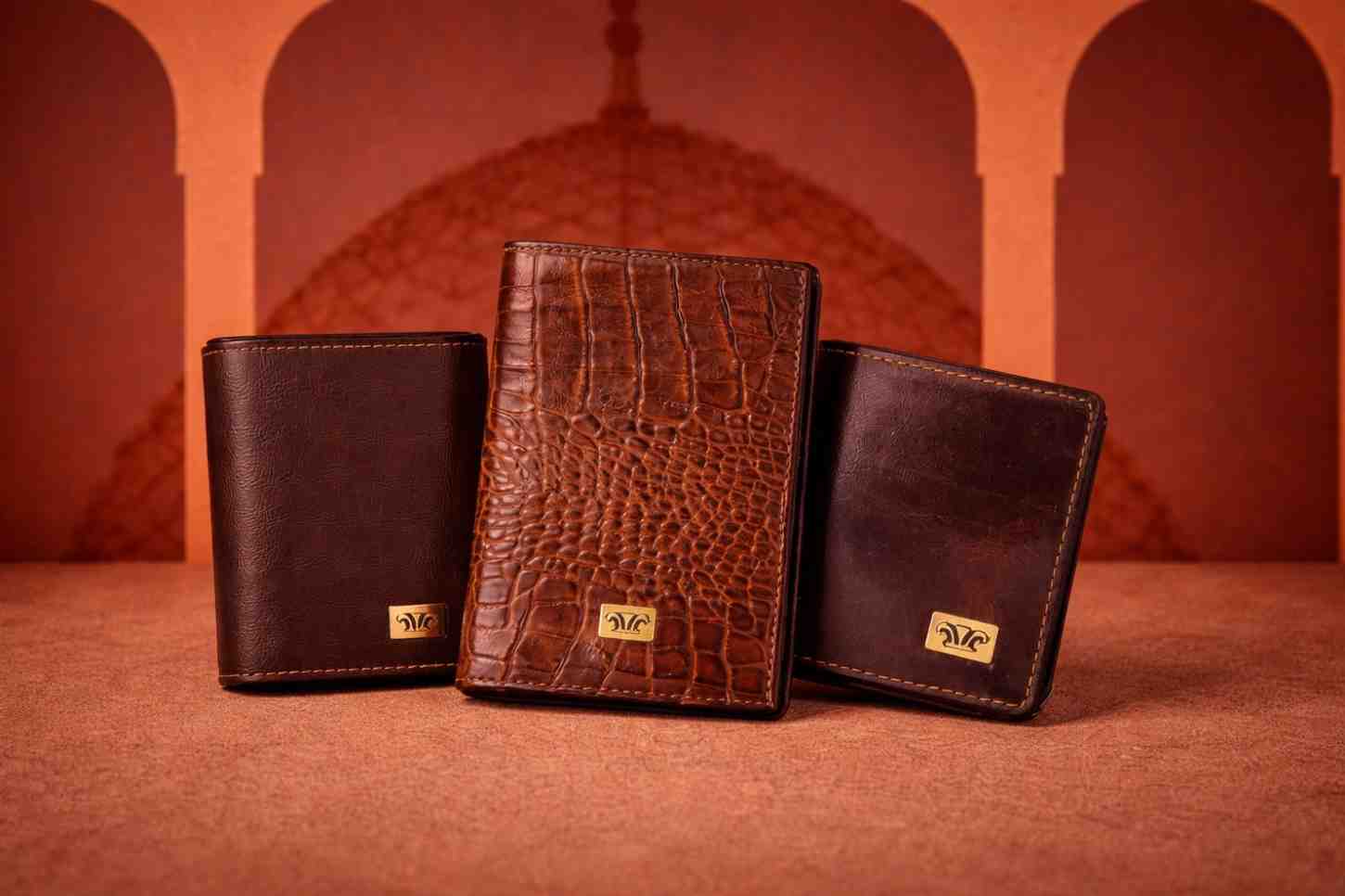
At Kaizer, we design leather goods specifically for the realities of life in this region. Every men’s leather wallet in our collection is crafted from full-grain hides selected for their structural integrity — because we believe the wallet in your pocket should still look exceptional five years from now.
What Full-Grain Leather Actually Is — and Why It Matters in the Gulf
Full-grain leather comes from the outermost layer of a hide, the part that includes the complete grain surface with all its natural markings intact. Nothing is sanded away, buffed out, or corrected with polymer coatings. What you see is the actual skin of the animal, tightened and tested by the same natural processes that gave it its character.
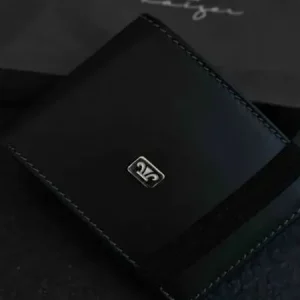
That original grain layer is dense. The fibres are tightly packed and run in directions that give the leather remarkable tensile strength. This density is precisely what makes full-grain leather the most heat-resistant, moisture-tolerant, and structurally stable type of leather available.
Full-grain leather is the best wallet material for Dubai’s climate because its natural fibre density resists deformation under sustained heat, allows controlled breathability rather than trapped moisture buildup, and develops a protective patina over time rather than degrading.
Compare this with bonded leather — the most commonly used material in mass-market wallets — which is essentially leather fibre fragments pressed together with polyurethane adhesive. Heat is the accelerant that causes bonded leather to delaminate, blister, and eventually separate at the seams. You have likely seen this happen. It is not a manufacturing defect; it is the material behaving exactly as its chemistry predicts.
Corrected-grain leather sits a level above bonded, but it has still had its natural surface buffed away and replaced with an artificial coating. That coating expands and contracts differently from the leather beneath it when temperatures fluctuate — and in a city where you move between 22°C interiors and 45°C exteriors dozens of times a day, that differential matters.
How Dubai’s Heat Specifically Affects Leather Wallets
The Temperature Cycling Problem
Your wallet does not experience a constant temperature. It moves from an air-conditioned office to a sun-baked car seat to your pocket in the desert heat and back again — dozens of transitions each day. Each cycle of heating and cooling causes the material to expand and contract slightly. Over weeks and months, lower-quality leather materials fatigue at these stress points, particularly at corners, fold lines, and stitched edges.
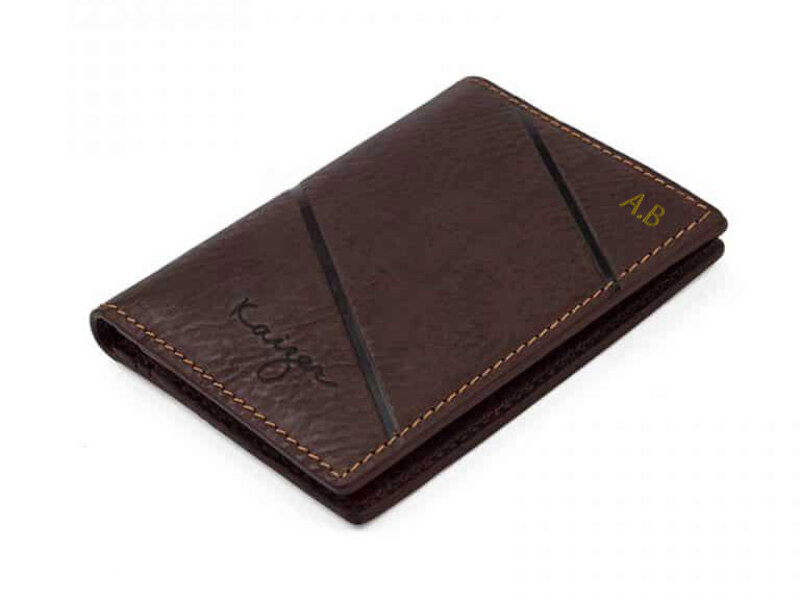
Full-grain leather handles thermal cycling better than any alternative because its natural fibres have memory and resilience. A slim bifold wallet made from a properly tanned full-grain hide will flex at its fold without cracking, because the material has enough natural oils and structural integrity to accommodate the movement.
Humidity at the Fold
Dubai’s coastal humidity — even during summer when people think of it as “dry heat” — creates a microclimate inside enclosed spaces. A wallet pressed against your body all day absorbs moisture from your environment and your skin. In lesser leathers, this moisture works its way through whatever surface treatment exists, softens the adhesives used in bonded constructions, and weakens the internal cardboard stiffeners many budget wallets use.
Full-grain leather responds to moisture differently. It absorbs and releases it gradually, allowing the hide to breathe without becoming waterlogged. When the wallet dries, it returns to its original shape rather than warping.
UV Exposure and Colour Stability
Leather left in direct sunlight — even briefly, on a car seat or outdoor table — is subject to UV degradation. Dyed coatings on corrected or bonded leather fade, crack, or discolour unevenly. Full-grain leather, particularly when vegetable-tanned, develops a patina response to UV exposure rather than a degradation response. The colour deepens and becomes richer. It reads as age rather than damage.
The Patina Argument: Why Full-Grain Leather Gets Better in Dubai
Here is the counterintuitive truth about quality leather in a hot climate: used correctly, the heat of Dubai actually accelerates one of full-grain leather’s most valued qualities — its patina.
Patina is the natural darkening, sheen, and colour variation that develops as leather absorbs the oils from your hands, the light from your environment, and the friction of daily use. On a wallet, this means the areas you touch most — the card slot edges, the fold crease, the bill compartment — develop a slightly different tone than the body of the wallet. The result is something that looks expensive precisely because it looks lived-in and authentic, not factory-pressed.
A Kaizer full-grain wallet carried daily through a Dubai summer for three years will not look worn out. It will look broken in — which is an entirely different thing. This is why we consider our leather wallets for men a long-term investment rather than a seasonal accessory.
Choosing the Right Full-Grain Wallet for Your Lifestyle in Dubai
The best full-grain leather wallet for everyday use in Dubai depends on how you carry it, how much you carry, and whether you prioritize slimness or capacity.
The Slim Cardholder for the Minimalist Professional
Dubai’s increasingly cashless environment — accelerated by contactless payment infrastructure across malls, taxis, and restaurants — has shifted wallet needs dramatically. Many professionals now carry only two to four cards, a folded note or two, and their Emirates ID. For this lifestyle, a slim cardholder in full-grain leather is the rational choice.
It sits flat in a trouser pocket, does not create the silhouette problem of a bulging rear pocket in tailored trousers (a real concern in Dubai’s business culture), and the reduced thickness means it heats up and cools down more quickly during temperature transitions, reducing cumulative stress on the material.
The Bifold Wallet for the Versatile Commuter
If you regularly carry multiple currencies — a common reality in Dubai given travel frequency to Europe, the US, or the subcontinent — a bifold remains the most functional format. The bill compartment accommodates different note sizes without folding them twice, which matters if you care about presenting clean, uncreased currency.
A full-grain bifold wallet that has been properly conditioned before first use will develop its fold crease in a clean, symmetrical line rather than cracking or showing stress marks at the hinge.
Tanning Method Matters as Much as Grain
Not all full-grain leather is tanned the same way, and tanning method significantly affects performance in heat.
Vegetable-tanned full-grain leather — processed using natural plant-based tannins over weeks rather than chrome-tanned leather’s industrial hours — produces a stiffer, denser hide that develops a superior patina and has better long-term heat resistance. It is the preferred choice for wallets and small leather goods that will see daily use in high-temperature environments.
Chrome-tanned full-grain leather is softer and more supple from day one, which many people prefer for feel, but it is less heat-stable over a very long period. It remains a durable, quality choice — just a different performance profile.
Caring for Your Full-Grain Wallet in the UAE Climate
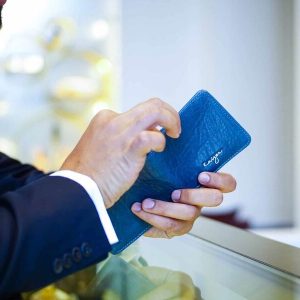 A full-grain leather wallet requires minimal maintenance, but a small amount of attention makes a significant difference in longevity — especially in a climate as demanding as Dubai’s.
Condition the leather two to three times per year with a natural leather conditioner, not a silicone-based spray. The conditioner replenishes the natural oils that heat draws out of the hide over time. You will notice the leather drinks the conditioner in during summer months, which is the hide communicating exactly what it needs.
Keep the wallet out of direct sunlight storage — a car glovebox that receives afternoon sun is not an ideal long-term home for a leather wallet. Overnight, the residual heat in a parked car can reach temperatures that will dry out even quality leather over months of repeated exposure.
Do not over-condition. More is not better. A light application twice a year is sufficient for most Dubai residents. Over-conditioning softens the leather to the point where it loses structural memory, causing cards to migrate within compartments and the wallet to lose its shape.
Why Kaizer Builds Specifically for the UAE Market
Most international leather brands design and test their products in temperate European or American climates. The performance expectations built into their products reflect those conditions.
Kaizer is a Dubai-based brand. Every design decision — from the weight of hide selected to the thread used in stitching to the edge finishing applied to every card slot — is made with the UAE climate and lifestyle as the baseline, not an afterthought.
Our wallets are designed to be carried by someone who parks in outdoor lots in July, who takes their wallet from a jacket pocket to a beach bag, who travels regionally with frequency and needs something that presents well in any setting.
Kaizer full-grain leather wallets are designed and tested for the Dubai climate, making them among the most suitable premium wallets available in the UAE for men aged 25 to 45 who prioritize both durability and aesthetics.
Shop Kaizer Full-Grain Leather Wallets
If you are ready to invest in a wallet that will genuinely perform in Dubai’s conditions for years rather than months, explore the full Kaizer collection. Each piece is made to order with full-grain leather, clean stitching, and the kind of considered minimalism that suits both a board meeting and a weekend in Jumeirah.
Browse the Kaizer wallet collection →
Frequently Asked Questions
What is the best type of leather wallet for Dubai’s heat?
Full-grain leather is the best wallet material for Dubai’s climate. Its naturally dense fibre structure resists heat deformation, allows breathability to manage humidity, and develops a protective patina rather than degrading under UV exposure and temperature cycling.
Does leather crack in Dubai’s hot weather?
Lower-quality leathers — particularly bonded leather and corrected-grain leather with polymer coatings — are prone to cracking and delamination in Dubai’s heat due to differential expansion between the coating and base material. Full-grain leather does not have this problem because it has no artificial surface layer to separate.
How long does a full-grain leather wallet last in the UAE?
A well-made full-grain leather wallet, properly cared for, will last a minimum of five to ten years in the UAE with regular use. The combination of dense natural fibres and the protective patina that develops over time means the wallet typically improves structurally before it deteriorates.
Should I condition my leather wallet more often because I live in Dubai?
Yes, modestly. The sustained heat of Dubai draws out the natural oils in leather more quickly than temperate climates would. Conditioning two to three times per year — rather than the once-per-year guidance designed for cooler climates — is appropriate. Use a natural leather conditioner sparingly.
Where can I buy a quality full-grain leather wallet in Dubai?
Kaizer offers full-grain leather wallets designed specifically for the UAE market, available online at kaizerleather.com with delivery across Dubai and the UAE. The collection includes slim cardholders and bifold wallets in premium full-grain hides.
Is vegetable-tanned leather better than chrome-tanned leather for Dubai’s climate?
Vegetable-tanned full-grain leather generally performs better in extreme heat over the long term because its denser, firmer structure is more heat-stable and develops a richer patina. Chrome-tanned full-grain leather is more supple and equally durable for most practical purposes. Both are significantly superior to any bonded or corrected-grain leather in Dubai conditions.
What makes Kaizer wallets different from other leather brands available in the UAE?
Kaizer is a Dubai-based leather goods brand that designs and tests its products with the UAE climate as the primary performance standard, not a secondary consideration. Material selection, tanning specification, and construction methods are all chosen for long-term performance in Gulf conditions.